
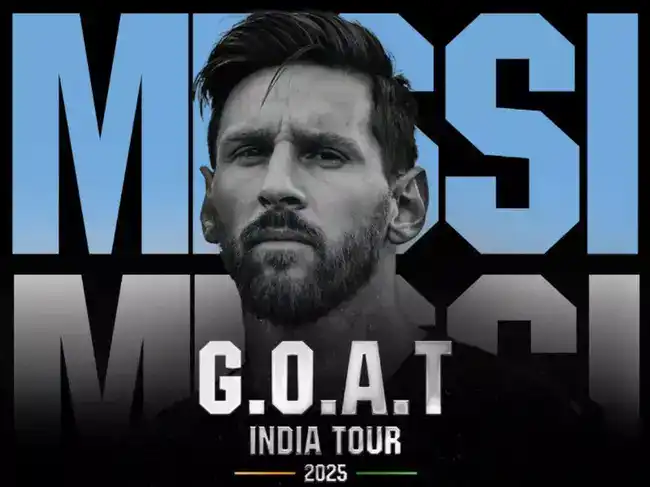
Lionel Messi has finally set foot in India again after 14 long years, and the country has responded exactly as you’d expect: with noise, colour, madness, and, unfortunately, chaos.
His much-hyped “G.O.A.T India Tour 2025” kicked off in Kolkata today, meant to be a three-day celebration that would take Messi across multiple cities with concerts, youth football events, celebrity appearances and charity programmes. Instead, day one at Kolkata’s Salt Lake Stadium ended with ripped seats, angry fans on the pitch, an arrested organiser and a public apology from the West Bengal Chief Minister.
Here’s everything that has happened in the past few days, what’s going on right now, his upcoming schedule, and the controversies surrounding this historic – and messy – visit.
The Build-Up: India Waits 14 Years for the G.O.A.T
Messi last played in India back in 2011 in an international friendly at the same Salt Lake Stadium. Fourteen years later, his return was packaged as a once-in-a-lifetime spectacle: “G.O.A.T India Tour 2025 – A Satadru Dutta Initiative.”Posters and billboards with Messi’s face went up in Kolkata, Mumbai and Delhi, ticket sites crashed, and fan hype went into overdrive.
The official tour plan promised:
- Multi-city events across Kolkata, Mumbai and Delhi (with some reports mentioning Ahmedabad/Hyderabad as additional stops).
- Celebrity matches and exhibition events.
- Youth clinics and football activities.
- Concerts and cultural performances.
- Charity events and high-profile appearances with Indian icons from cricket, Bollywood and politics.
Ticket prices reflected the hype: general stands starting around ₹3,500–₹4,000 and premium/VIP packages going up to tens of thousands of rupees, including meet-and-greet and hospitality.
For many fans, this wasn’t just another event. Stories surfaced of a newlywed couple postponing their honeymoon just to see Messi in person, and others travelling from different states after following him for more than a decade.
Day One in Kolkata: Frenzy at Dawn, Fury by Afternoon
Packed stands, huge expectations
Kolkata – often called the football capital of India – was chosen as the grand opening venue. From early morning, fans in Argentina jerseys with “MESSI 10” printed on the back started filling Salt Lake Stadium (Vivekananda Yuba Bharati Krirangan). Estimates suggest around 60,000 people were inside, with thousands more outside.
People had waited for hours in winter conditions, expecting a full programme: celebrity appearances, speeches, and Messi spending close to 45–60 minutes engaging with the crowd.
Earlier in the day, Messi had also virtually unveiled a 70-foot statue of himself in Kolkata, another symbol of the city’s obsession with him.
Messi’s brief appearance
When Messi finally walked onto the pitch, he was surrounded by a ring of security personnel, organisers, officials and VIPs. He managed a short lap of honour, waved to fans along one corner of the stadium, and then — very quickly — was escorted off the ground.
Most international reports agree that:
- His appearance lasted around 20 minutes, despite promotions suggesting about 45 minutes or more.
- Many fans in the upper tiers never got a clear view of him, as the inner circle around Messi and poor big-screen visibility blocked the experience.
Chaos, vandalism and police action
Once spectators realised Messi had left and that the event was effectively over, the mood flipped. Anger over high ticket prices and a very short appearance boiled over.
According to multiple eyewitness accounts and global media reports:
- Fans ripped up plastic seats and hurled them towards the pitch.
- Bottles and other objects were thrown from the stands.
- Barriers were pushed down and large numbers of fans invaded the pitch.
Security forces eventually cleared the field, but not before images and videos of the chaos went viral worldwide, turning what was meant to be a proud moment for Indian football into a PR disaster.
Political Fallout: CM Apology and Organiser Arrested
The incident triggered immediate political and administrative reactions.
West Bengal Chief Minister Mamata Banerjee issued a public apology to Messi and to fans, saying she was “deeply disturbed and shocked” by what happened at Salt Lake Stadium. She announced a high-level probe led by a retired Calcutta High Court judge, with senior state officials on the committee.
In parallel, state police detained Satadru Dutta, the chief organiser and promoter of the GOAT India Tour, promising action against those responsible for the mismanagement.
The key allegations being examined:
- Overselling or overcrowding of certain sections.
- Poor communication about what the event actually included (many expected more football, or a longer interaction).
- Inadequate crowd management and exit planning.
- Priority treatment for VIPs and politicians that blocked normal fans’ view of Messi.
What’s Happening Now?
As of now:
- Messi has already left the stadium and, according to several live update feeds, moved on towards the next leg of his tour, with travel to another Indian city (reports vary between Hyderabad, Mumbai and onward connections, depending on the outlet).
- Clean-up and damage assessment are underway at Salt Lake Stadium after vandalism on seats, banners and other property.
- The state government’s probe is being set up, with questions already being raised about future large-scale events and the role of private organisers.
On social media, the mood is split: some fans blame organisers and VIP culture, others criticise the behaviour of angry supporters who damaged public property. Many simply express heartbreak that a once-in-a-lifetime chance to see Messi turned into a stampede of frustration instead of celebration.
Messi’s India Schedule: What’s Next on the GOAT Tour?
Despite the Kolkata chaos, the wider G.O.A.T India Tour 2025 is officially designed as a three-day, multi-city programme. Exact details may shift after today’s events, but based on pre-tour schedules:
Kolkata – 13 December
- Grand opening and fan event at Salt Lake Stadium.
- Short lap of honour and appearances with local legends and dignitaries.
- Cultural performances and concerts (many acts were reportedly overshadowed by the chaos and early end).
Mumbai – 14 December
- Events planned at Wankhede Stadium, including the “Padel GOAT Cup” and celebrity appearances from Bollywood and Indian cricket.
- Possible participation from icons like Sachin Tendulkar and other stars, depending on final confirmations.
Delhi – 15 December
- Closing ceremony at Arun Jaitley Stadium, with fan interactions and a formal felicitation.
- Several reports have suggested a potential meeting with Prime Minister Narendra Modi, though that has not been officially detailed in all outlets.
Some early planning documents and cricket-news portals also mentioned an event linked to Ahmedabad/Adani Sports Complex and foundation work around youth sports promotion, but those details are less visible in today’s live coverage and may be more limited or invite-only.
The Big Controversies Around Messi’s India Visit
1. Ticket prices vs. experience
One major flashpoint is the huge gap between fan expectations and what they actually got for their money.
- Ticket prices went up to ₹12,000 or more for some seats and packages.
- Many fans said they saw Messi only briefly, from far away, or not at all because the giant display screens weren’t properly used or VIP clusters blocked the view.
That combination – high cost + low perceived value – is at the heart of today’s anger.
2. Miscommunication about what the event actually was
Some fans went in expecting an exhibition match or a longer football segment. In reality, Kolkata’s stop was more like a ceremonial appearance, a lap of honour and a short programme with dignitaries.
The promotional material talked about matches, penalty shootouts and masterclasses as part of the tour as a whole, which seems to have created confusion about what each city would get.
3. VIP culture and political optics
Videos and ground reports show a thick ring of VIPs – politicians, business leaders, and special guests – surrounding Messi during much of his time on the pitch. That not only blocked views but also symbolised something Indian fans complain about regularly: VIP zones getting the best of everything while regular ticket-buyers are squeezed out.
This has already turned into a broader debate about event management and fairness rather than just a football story.
4. Safety and stadium management
Any time tens of thousands of people are packed into a stadium with weak communication, blocked exits and high emotions, things can turn dangerous fast.
Global outlets like Reuters, AP, Al Jazeera, Sky News and others have highlighted:
- Barricades being broken.
- Fans jumping fences and running onto the field.
- Children and families caught in the rush.
Thankfully, there are no reports yet of major casualties, but the mismanagement has raised serious questions about India’s readiness to host mega star-centric events of this scale.
What This Visit Means – And What Comes Next
Even after a chaotic first day, the core truth remains: Lionel Messi’s presence in India is historic.
From fans postponing honeymoons and skipping big life events, to kids painting Argentina flags on their cheeks, this tour shows just how deep football fandom runs here, far beyond club and country lines.
But Kolkata has also become a warning sign. If the rest of the GOAT India Tour has to succeed, organisers and authorities in Mumbai and Delhi will have to:
- Clearly communicate the format and duration of events.
- Fix crowd control, entry, exit and seating issues.
- Respect the fact that many fans are spending a big chunk of their monthly income for just a few minutes of magic.
For now, the images from Salt Lake Stadium – Messi walking quickly around the pitch, followed by a sea of VIPs, and then a furious crowd ripping out seats – will dominate headlines. The next two days will decide whether this India tour is remembered as a celebration of football or a case study in how not to manage a mega-star event.
Either way, Messi has once again proved something: even a 20-minute walk in a stadium can shake an entire country.